Додайте товари до списку бажань
0
Додайте товари до кошика
Інформація про електронні товари

У зв'язку з обмеженями платформи сайту щодо максимального об'эму завантажувальних файлів (не більше 25 МБ), замовити електронну версію наших книжок Ви можете лише наступним чином:

1. Додайте обраний товар до кошику
2. Натисніть "Оформити замовлення"
3. Заповніть поля даних для зв'язку з вами (ПІБ, телефон)
4. ОБОВ'ЯЗКОВО! Оберіть спосіб доставки САМОВИВІЗ
5. Зробіть оплату онлайн

Після підтвердження оплати замовлення, з Вами зв'яжеться менеджер і надішле файл з електронною книгою! 
Ми приносимо вибачення за ці незручності та сподіваємось, що це тимчасово і платформа прийме відповідні зміни щодо ситуації.

Електронний продукт надається у форматі epub. Для зручного використання файлу рекомендуємо додаток «Play Books».

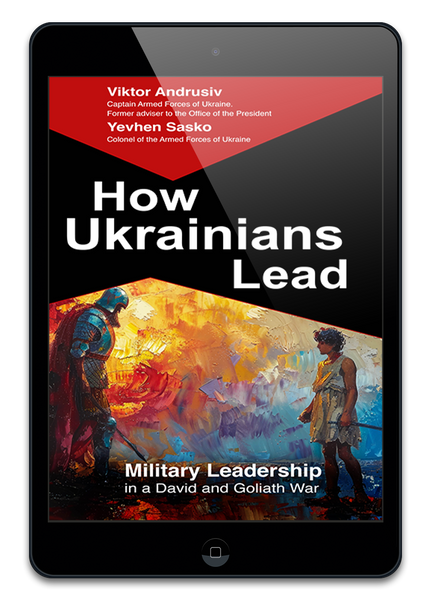
How Ukrainians lead military leadership: The Ukraine case study

В наявності
Артикул: EN12345E
130 грн
Електронний товар
Увійдіть на сайт щоб
додати товар в список бажань
Характеристики
Автор 
Віктор Андрусів, Євген Сасько
Жанр 
Військова література
Тип видання 
Електронне
Формат файлу 
epub.
Кількість сторінок 
156
Рік видання 
2025
Опис

In 2014, as Putin’s troops occupied Crimea, Ukraine’s army was in disarray, having been deliberately run down by president Viktor Yanukovich. In 2022, when Russia launched its all-out invasion of Ukraine, the enemy met a military transformed.  Moscow boasted its army would be in Kyiv in three days. In the 60-kilometre long Russian armoured column aimed at Kyiv, enemy troops had packed their dress uniforms anticipating a ‘victory’ parade in the Ukrainian capital.  The assessment of Western allies gave Ukraine little or no chance at the onset of the David and Goliath battle.  Ukrainians had other ideas. Across the country ordinary people self-mobilised. That defiance – historical, visceral and spontaneous – was distilled in the Ukrainian military, a ‘new model’ army more than ready to face the existential challenge.  The hubris of ‘three days in the capital’ became the Battle of Kyiv; and after 30 days Russian forces were in full retreat across north Ukraine.  Now, for the first time, some of the architects of the transformation of the Armed Forces of Ukraine (AFU) tell their story in a remarkable book HOW UKRAINIANS LEAD They include former AFU Chief of Staff General Valeriy Zaluzhnyi who is now Ukraine’s ambassador to London. The candour of the contributors and the fact that the book is being published are testament to a key theme in the transformation of the AFU: jettisoning the Soviet era mentality that still informs the Russian army.  One difference illustrates the wider trend. The Russian army still uses its infamous ‘barrier’ units, troops tasked with ensuring advancing units do not retreat, by shooting them if necessary.  There is no such thing in the Ukrainian military.  The years since 2014 saw reforms across all areas of the AFU, from military philosophy and training to command and control and armed forces infrastructure.  Key to it all was the critical issue of leadership, not just at the highest levels but cascaded through the ranks. The new military doctrine rejected the Soviet/Russian approach with its rigid hierarchies, rule by fear and the brutal suppression of all individual initiative.  In its place the AFU moved to a philosophy where outcomes trump processes, flexibility and initiative are encouraged and responsibility is devolved through the ranks.  Many small differences added up to the difference that enabled the far smaller Ukrainian military with far fewer weapons systems, to take on and more than equal the Russian invader.  The roll call of resulting success included the sinking of the Russian Black Sea flagship Moskva, the Kharkiv counter-offensive, the recovery of occupied Kherson and the Operation ‘Spider Web’ drone attack on Russia’s strategic bomber fleet.  The rules of war are being rewritten not by Russia but by Ukraine which has created a new paradigm for military leadership that puts a premium on creativity, flexibility and the taking of responsibility at all levels.  One commander deployed his troops on the eve of the full-scale invasion despite receiving no written order. It was an act that could have seen him arrested and tried. In short, he took responsibility and acted. He led.

Новий відгук або коментар
Увійти за допомогою
Оцініть товар

We care about your privacy!

This website uses cookies for marketing and statistical purposes, as well as for the safe and optimal operation of the site. You can change this in your browser settings. Click the "Agree" button to consent to the use of cookies. For more information, see the User Agreement page .